At a glance
- Municipalities
- Gozón (Luanco and Cabo Peñas) and Carreño (Candás)
- Lighthouse centre
- €1 adults; €0.50 ages 4–14 and groups (Gozón council)
- Antón Museum (Candás)
- Free entry; closed on Mondays
- Without a car
- Candás has a commuter rail station (line C-4); ALSA buses to Luanco
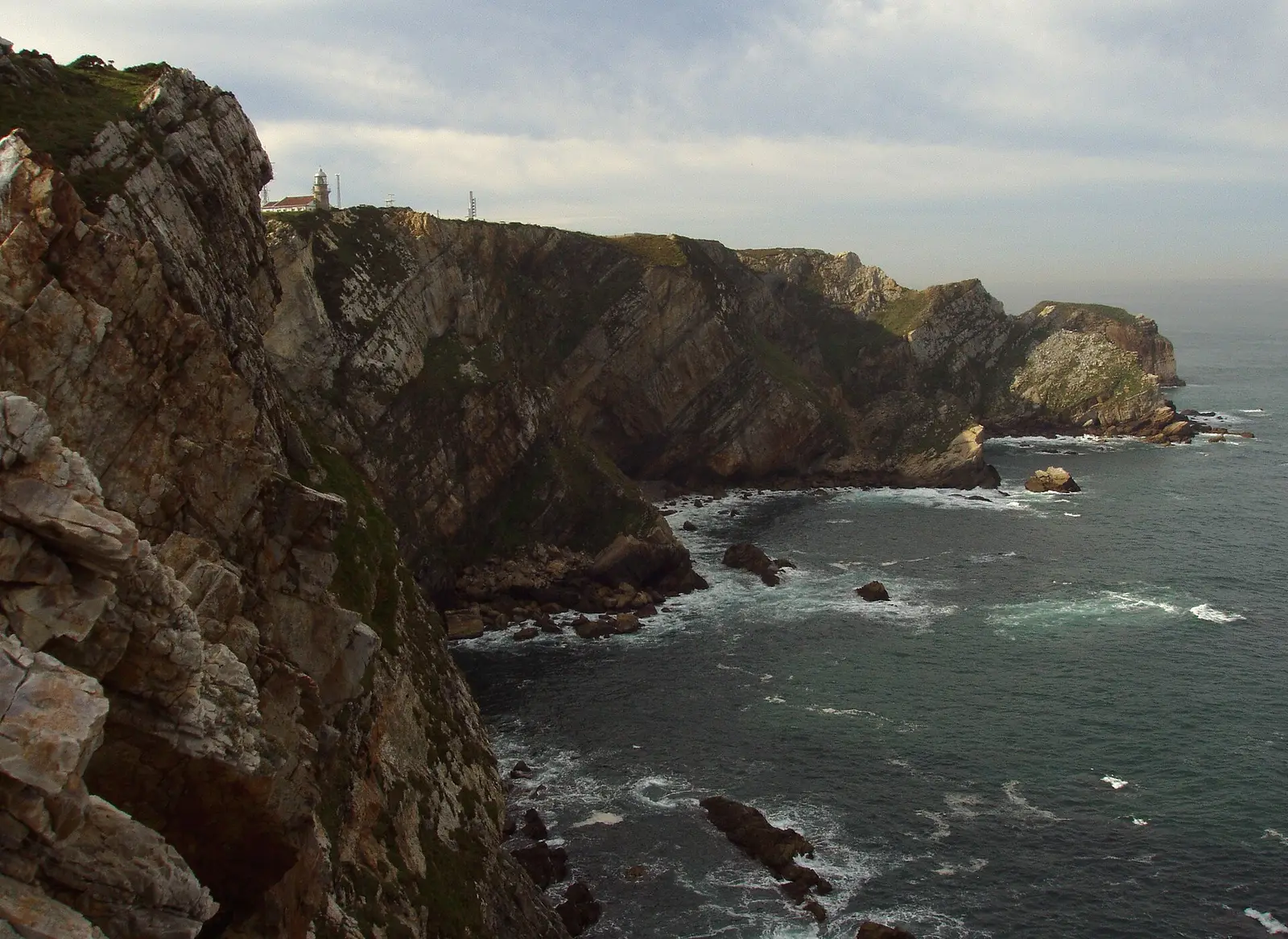
Cabo Peñas (Peñes in Asturian) is the northernmost point of Asturias and one of the most rewarding short trips from Gijón/Xixón: a lighthouse on top of cliffs almost a hundred metres high, a boardwalk out to the edge, and two fishing towns, Candás and Luanco, with small museums and a long tradition of fish and pastries. It fills an afternoon if you keep moving, or a relaxed full day. The thing that matters most is the weather on the cape itself.
Before you go: check the sky, not just the calendar
The cape is very exposed. In a strong wind the boardwalk is hard work, and in low fog you can reach the lighthouse and not see the sea at all. Check the forecast on AEMET, Spain’s national weather service, and keep a plan B in mind (see below). Our page on Gijón’s weather explains how quickly conditions change on this coast.
Also check the opening hours of the lighthouse interpretation centre. Gozón council does not publish fixed hours and refers visitors to the Luanco tourist office (+34 985 882 644), while the Turismo Asturias listing gives different times. If going inside matters to you, phone first.
How to plan the route from Gijón
A car is by far the easiest option, because the lighthouse is well away from the towns. An order that works well, heading east to west:
- Candás: the harbour and the Antón Museum (outside summer it only opens in the morning at weekends; hours below).
- Luanco: the old town, the Maritime Museum and lunch. Spanish lunch usually runs from about 13:30 to 15:30.
- Cabo Peñas: lighthouse, boardwalk and interpretation centre in the afternoon.
If you set off late, flip it: the cape first while the light lasts, then dinner in Luanco or Candás. For a longer day, carry on west from the cape and finish in Avilés.
Without a car you can do part of it. Candás has a station on the C-4 commuter line (Gijón–Cudillero), a narrow-gauge line run by Renfe that locals still call FEVE, starting from Gijón-Sanz Crespo station. ALSA also runs buses from Gijón to Candás and Luanco. Check times on renfe.com, alsa.es and the Asturias Transport Consortium. We could not confirm a regular bus to the lighthouse, so by public transport it is realistic to stick to Candás and Luanco.
Cabo Peñas and its lighthouse
The Peñas lighthouse has been working since 1852 and stands about 60 metres back from the cliff edge, according to Turismo Asturias. It is one of the few lighthouses in Spain that still has a resident keeper. Around it lies the Cabo Peñas Protected Landscape, some 19 km² of the Gozón municipality, protected since 1995 and also part of the EU’s Natura 2000 network.
What to do there:
- The boardwalk: it starts at the interpretation centre entrance and runs to the cliff edge, with panels on geology, plants, wildlife, archaeology and whales and dolphins. It is there to protect the ground, so please stay on it.
- Look out to sea: from the cape you can see a long stretch of the Asturian coast and several islets, including La Erbosa, the second-largest island in the region. Bring binoculars if you like birds: Turismo Asturias highlights the European shag and the storm petrel.
- The interpretation centre: on the lighthouse’s ground floor, with five rooms (lighthouses, shipwrecks and storms, the sea off Cabo Peñas, the marine environment and a “window on Gozón”) using effects and simulations. Entry is €1, or €0.50 for children aged 4 to 14 and groups of 15 or more, according to Gozón council. Turismo Asturias lists it as having step-free access and accessible movement inside.
Tip: even on a fine day in Gijón, the cape is windier. Bring an extra layer and shoes with good grip in case the boardwalk is wet, and stay away from the edge outside the marked areas.
If you want more walking, the Senda Norte is a flat coastal path with sections between Verdicio and Cabo Peñas, between Bañugues and Luanco, and between Perlora and Xivares. Near the cape are the dune systems and beaches of Xagó and Verdicio; Xagó is also popular with surfers (see surfing in Gijón).
Luanco: the town closest to the cape
Luanco (Lluanco), the main town of Gozón, has an old centre protected as a historic site since 1991. For a short visit:
- The clock tower (Torre del Reloj), from the 18th century, a rare example of public architecture from that period. It has served as a lookout, a jail and a storehouse.
- Santa María church, almost on the seafront, home to the Cristo del Socorro, a crucifix that tradition credits with saving a group of sailors from a storm in the 17th century.
- The promenade and harbour, with the town beaches of Luanco and La Marina.
- The Maritime Museum of Asturias, founded in 1948 and the oldest museum in the region: model boats, fishing gear, sea charts and the whaling and canning history of the area. Check opening hours and prices on its Turismo Asturias listing before you go.
Candás: sardines, sculpture and the dolphin trial
Candás is the main town of Carreño, with a whaling and canning past. It also has one of the odder stories on this coast: in the 17th century its fishermen took the dolphins to court for scaring off their catch, and a notary read out the sentence from a boat. A monument recalls the episode.
- Antón Sculpture Museum (Centro de Escultura de Candás Museo Antón): devoted to the sculptor Antonio Rodríguez García, known as Antón, in an 18th-century house with a sculpture garden. Entry is free. According to its official website, from October to May it opens Tuesday to Friday 17:30–19:30, and Saturday and Sunday 12:00–14:00 and 17:30–19:30; from June to September, Tuesday to Sunday 12:00–14:00 and 18:00–21:00. Closed on Mondays, 24, 25 and 31 December, and 1 and 6 January.
- The canning industry exhibition, in the former Bernardo Alfageme factory. According to Turismo Asturias, the town once had 24 canneries.
- The harbour, the promenade and the San Antonio lighthouse on the clifftop.
If you have already been around Gijón: the Casa de los Valdés at the Museum of the Asturian People is a 17th-century manor house moved there from Candás.
Food and festivals
Both towns are known for marañuelas, bow-shaped butter biscuits (more in Asturian desserts). In Candás the signature dish is grilled sardines; in Luanco the traditional catch includes bonito tuna, sardines, mackerel, pixín (monkfish), spider crab, velvet crab and goose barnacles.
Turismo Asturias places Candás’s Sardine Festival in early August and its Cristo festival in mid-September; in Luanco, the Cristo del Socorro is celebrated in February and the Bonito Festival in late June. Check each year’s dates on the council websites before planning a trip around a festival.
If it rains or the fog rolls in
No need to cancel: just change the order. In fog, skip the cape and spend the day on the museums (the Maritime Museum in Luanco, the Antón Museum and the canning exhibition in Candás) and a long lunch. If the weather is truly grim, Avilés with its arcaded streets is the nearest alternative, and back in the city there are ideas in rainy day in Gijón.
More nearby
- Back in Gijón, the Campa Torres is another headland with a lighthouse and views over the Carreño coast, without leaving the city’s municipality.
- To end the day watching the sun go down, see the best sunsets in Gijón.
- For closer beaches with facilities, see Gijón’s beaches, and for a seaside walk without the car, the coastal path.
- All the other options are in day trips from Gijón.
Frequently asked questions
Can you go inside the Cabo Peñas lighthouse?
Not up the tower, but the ground floor houses the Peñas Marine Environment Visitor and Interpretation Centre, with five rooms on lighthouses, shipwrecks and the cape's sea life. According to Gozón council, entry is €1 (€0.50 for ages 4 to 14 and groups of 15 or more). Opening hours must be checked with the Luanco tourist office (+34 985 882 644). The grounds and the clifftop boardwalk are open to walk freely.
What is the northernmost point of Asturias?
Cabo Peñas (Peñes in Asturian), in the municipality of Gozón. Turismo Asturias describes it as the region's northernmost point, with cliffs that drop almost a hundred metres straight into the sea.
Can I get from Gijón to Candás and Luanco without a car?
Candás, yes: it is on the C-4 commuter line (Gijón–Cudillero, narrow gauge), and ALSA also runs buses. Luanco is reached by bus. The lighthouse is harder: we could not confirm a regular bus to the cape, so check alsa.es or the Asturias Transport Consortium before you set off.
Is there a walk at Cabo Peñas?
Yes. A wooden boardwalk with information panels runs from the interpretation centre entrance to the cliff edge. The Senda Norte, a flat coastal path, also has sections between Verdicio and Cabo Peñas, between Bañugues and Luanco, and between Perlora and Xivares, according to Turismo Asturias.
What can I do in the area if the weather is bad?
Head indoors: the lighthouse interpretation centre, the Maritime Museum of Asturias in Luanco and the free Antón Sculpture Museum in Candás. In thick fog the cape loses most of its appeal, so save the lighthouse for another day.
Sources
- Turismo Asturias – Cabo Peñas Protected Landscape — 4 November 2026
- Turismo Asturias – Cabo Peñas area — 4 November 2026
- Turismo Asturias – Peñas Marine Environment Visitor and Interpretation Centre — 4 November 2026
- Gozón council – Peñas Marine Environment Centre opening hours and prices — 4 November 2026
- Turismo Asturias – Luanco fishing town — 4 November 2026
- Turismo Asturias – Candás fishing town — 4 November 2026
- Turismo Asturias – Maritime Museum of Asturias — 4 November 2026
- Antón Sculpture Museum, Candás – Visitor information — 4 November 2026
- Wikipedia – C-4 (Cercanías Asturias) — 4 November 2026
- Wikipedia (ES) – Faro de Cabo Peñas — 4 November 2026
- ALSA — 4 November 2026
- Renfe – Cercanías Asturias — 4 November 2026