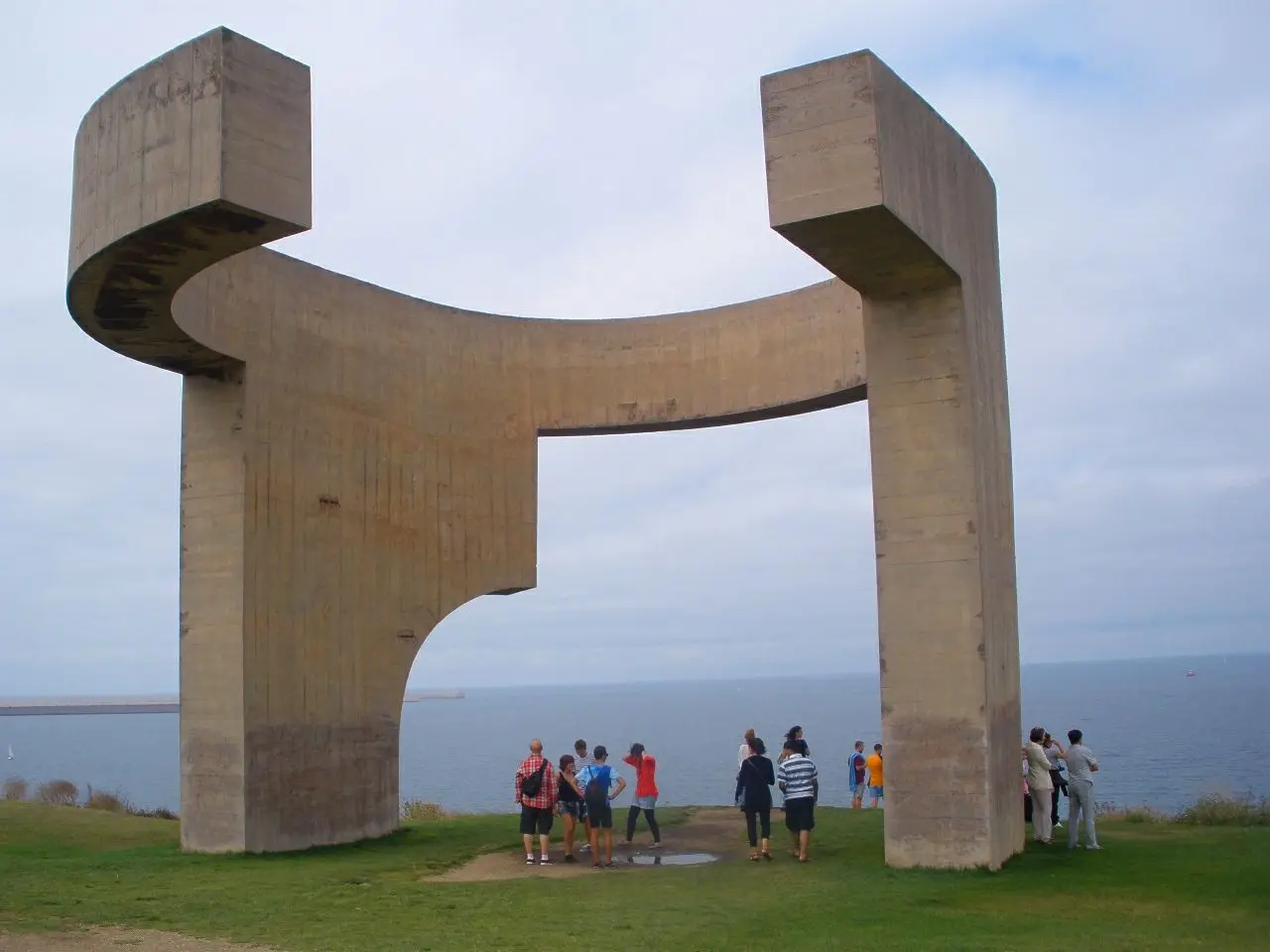
On the tip of the Cimavilla headland, high on Santa Catalina Hill, a huge concrete form frames the sky and the sea. This is the Elogio del Horizonte (“In Praise of the Horizon”) by Eduardo Chillida, one of Spain’s most celebrated 20th-century sculptors. It has become the symbol of Gijón and its finest viewpoint – and it is free and open around the clock.
The sculpture
Chillida conceived it as a great open arch in conversation with the horizon of the Cantabrian Sea. It was unveiled on 9 June 1990, stands about 10 metres high and weighs roughly 500 tonnes. From a distance it looks almost weightless, like a sign drawn on the sky; up close, its sheer mass is striking.
It is a piece to experience as much as to look at. Stand beneath the arch on a windy day and the hollow catches and amplifies the sound of the sea. Many visitors simply stop and listen for a few minutes.
Santa Catalina Hill
For centuries the hill was military ground – it was fortified in the 17th century to defend the coast from pirates and privateers. The city later acquired the land and turned it into a park, open since 1982. Today it is a high, open meadow overlooking the sea, with paths running around the headland. Look east for the bay and San Lorenzo beach, and west for the harbour and the port of El Musel.
Getting there and how long to allow
- On foot from the centre: cross the marina to Plaza del Marqués and climb through the streets of Cimavilla, or walk up from Plaza Mayor. The slopes are short but steep.
- Time: 30 minutes to an hour for the climb, the sculpture and a loop of the hill. Combined with the rest of the old town, allow half a morning.
- Accessibility: the park paths are wide but the gradients are steep. With a pushchair or limited mobility, take it slowly and stop along the way.
Tip: it can be very windy up there, even in summer. Bring a light jacket and hold on to hats and phones near the edge.
The best time to go
Sunset is the star moment, with the sun sinking over the sea and the sculpture in silhouette. For photos without people, go early in the morning. Windy days are best for hearing the sculpture “sing”. For more viewpoints, see the best sunsets in Gijón.
What to combine nearby
- Cimavilla: the Roman baths, Plaza Mayor, the Revillagigedo Palace and plenty of cider houses, just downhill.
- Nordeste: a steel sculpture by Joaquín Vaquero Turcios at the start of the path up the hill. More pieces in our guide to monuments and sculptures.
- San Lorenzo promenade: head down to the church of San Pedro and carry on along the seafront promenade.
Frequently asked questions
Is the Elogio del Horizonte free to visit?
Yes. It stands in a public park on top of Santa Catalina Hill and is open at all times.
Who made the Elogio del Horizonte?
The Basque sculptor Eduardo Chillida. It was unveiled in 1990 and is a concrete piece about 10 metres high, weighing around 500 tonnes.
What does 'Elogio del Horizonte' mean?
It translates as 'In Praise of the Horizon'. The sculpture frames the sky and the Cantabrian Sea, inviting you to look out towards the horizon.
Why does the sculpture make a sound?
On windy days, air rushes through the structure. Stand underneath the arch and the hollow amplifies the roar of the wind and the waves – one of the most memorable parts of a visit.
How do you get up Santa Catalina Hill?
On foot from Cimavilla, the old town. The climb is short but steep, and takes only a few minutes from Plaza Mayor or Plaza del Marqués.
Sources
- Wikipedia (ES) – Elogio del horizonte — 29 October 2026
- Wikipedia (ES) – Cimadevilla (Gijón) — 29 October 2026