Gijón has no cathedral to anchor a sightseeing day. Instead, its heritage is spread across the Roman and seafaring old town of Cimavilla, some remarkable 20th-century buildings and a collection of open-air sculpture facing the sea. This guide picks out the monuments worth your time, in an order you can follow on foot.
Historic buildings
Roman baths of Campo Valdés
The public baths of the Roman town, beneath the square of Campo Valdés next to the church of San Pedro. They are the most visible trace of ancient Gijón and can be visited as a museum: Roman baths of Campo Valdés.
Revillagigedo Palace and the collegiate church of San Juan Bautista
In Plaza del Marqués. The baroque palace was built between 1704 and 1721 under Francisco Menéndez Camina, around a 15th-century Gothic tower. The collegiate church, also baroque, was completed some fifteen years later. Together they form an ensemble declared a national monument in 1974, now used as a cultural and exhibition centre.
The Clock Tower (Torre del Reloj)
In Cimavilla, beside one of the old gateways into the Roman walled town. The original building, once the town hall and later a prison, was demolished in the early 20th century; the present tower was rebuilt between 1989 and 1995 and houses the city archive.
Jovellanos’s birthplace
The house where Gaspar Melchor de Jovellanos, Gijón’s great Enlightenment figure, was born is now a museum: Jovellanos Birthplace Museum.
Laboral City of Culture
The great monument of the 20th century: the former Universidad Laboral, by Luis Moya Blanco (1948–1957), is the largest building in Spain and has been heritage-listed since 2016. Full guide: Laboral City of Culture.
The seafront wall and the Escalerona
The San Lorenzo sea wall (1907–1916) and its grand 1933 staircase are part of the city’s landscape and memory: San Lorenzo promenade.
Statues and memorials
- Monument to Pelayo (Plaza del Marqués): unveiled in 1891, it honours the first king of Asturias, opposite the Revillagigedo Palace.
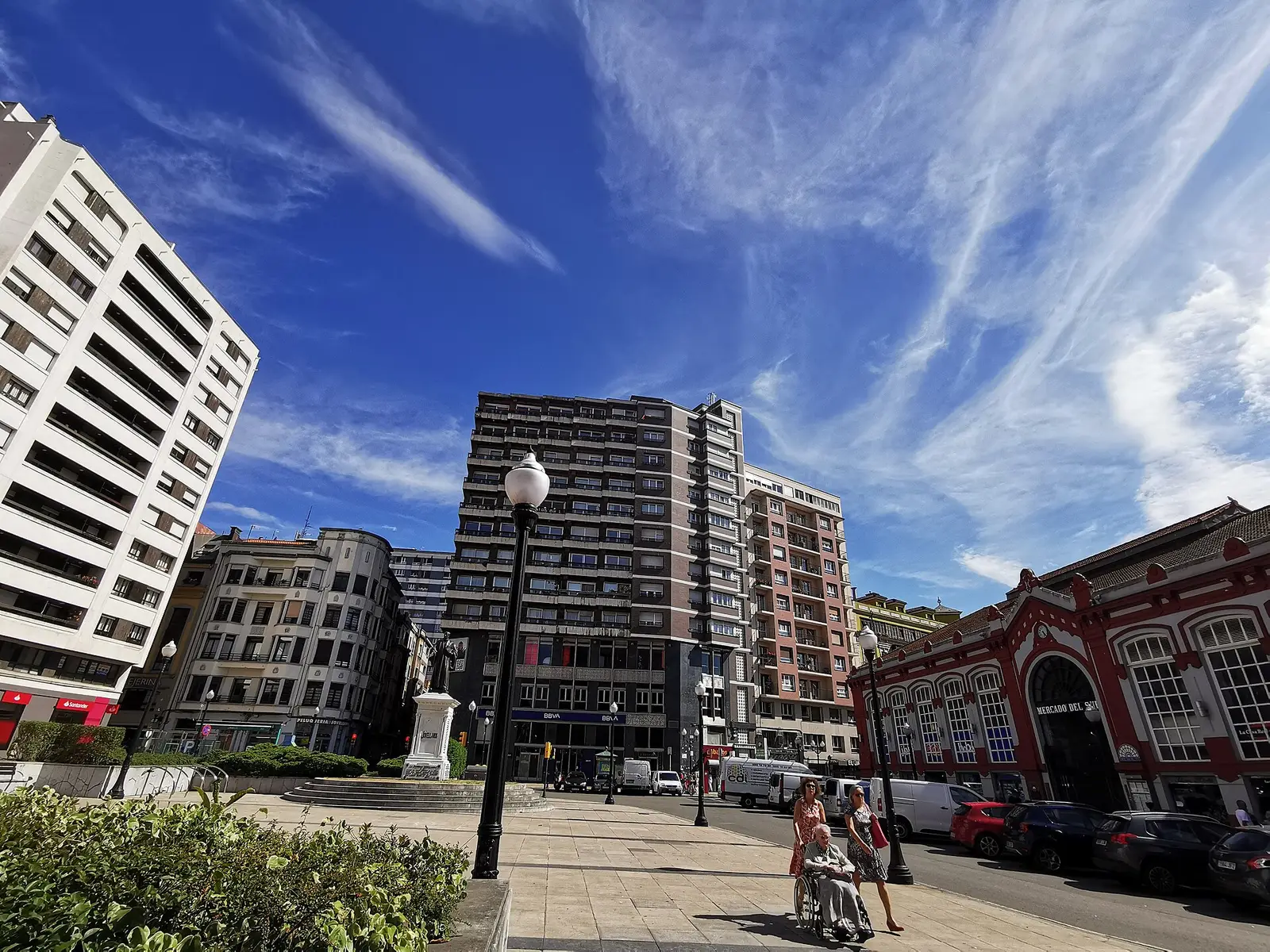
- Statue of Jovellanos (Plaza del Seis de Agosto): a bronze by Manuel Fuxá, unveiled on 6 August 1891 – the date that gives the square its name.
Contemporary open-air sculpture
- Elogio del Horizonte, Eduardo Chillida (1990): concrete, about 10 metres high, on top of Santa Catalina Hill. Unmissable.
- Nordeste, Joaquín Vaquero Turcios (1994): a steel piece on a concrete base where the path up Santa Catalina Hill begins.
- Monument to the Emigrant’s Mother (Madre del Emigrante), Ramón Muriedas (1970): on the El Rinconín promenade, a woman gazing out to sea in tribute to the mothers of those who emigrated to the Americas.
- Sombras de luz (“Shadows of Light”), Fernando Alba (1998): perforated weathering-steel panels on the El Rinconín promenade that play with the sunlight.
Tip: the El Rinconín sculptures come at the end of a lovely walk. Follow the San Lorenzo promenade, cross the Piles and continue east along the coast. In the late afternoon, with the sun low, Sombras de luz is at its best.
A walking route past the monuments (half a day)
- Plaza del Seis de Agosto: statue of Jovellanos.
- Plaza del Marqués: Pelayo, the Revillagigedo Palace and the collegiate church.
- Cimavilla: Jovellanos’s birthplace, the Clock Tower and Plaza Mayor (more in Cimavilla).
- Santa Catalina Hill: Nordeste and the Elogio del Horizonte.
- Campo Valdés: the Roman baths and the church of San Pedro.
- The seafront and El Rinconín: the Escalerona, the Emigrant’s Mother and Sombras de luz.
The Laboral is out on the eastern edge of town; give it another half-day together with the Botanical Garden. For the rest of the city’s cultural offer, see Gijón’s museums, and head back to things to see in Gijón to plan your route.
Frequently asked questions
What is the most famous monument in Gijón?
The Elogio del Horizonte by Eduardo Chillida, on Santa Catalina Hill. It is the symbol of the city and its finest viewpoint.
Where is the statue of Pelayo in Gijón?
In Plaza del Marqués, facing the Revillagigedo Palace beside the marina. It was unveiled in 1891.
What sculptures are there along Gijón's seafront?
At El Rinconín, east of San Lorenzo beach, you will find the Monument to the Emigrant's Mother by Ramón Muriedas and Sombras de luz by Fernando Alba. At the foot of Santa Catalina Hill stands Nordeste by Joaquín Vaquero Turcios.
Can you see Gijón's monuments for free?
Mostly, yes: the sculptures, squares and building exteriors are free to see. The Roman baths, the museums and the Laboral guided tour charge admission.
Sources
- Wikipedia (ES) – Palacio de Revillagigedo — 28 October 2026
- Wikipedia (ES) – Elogio del horizonte — 28 October 2026
- Wikipedia (ES) – Torre del Reloj (Gijón) — 28 October 2026
- Wikipedia (ES) – Universidad Laboral de Gijón — 28 October 2026
- Wikipedia (ES) – Playa de San Lorenzo (Gijón) — 28 October 2026
- Real Academia de la Historia – Manuel Fuxá y Leal — 28 October 2026
- Turismo Asturias – Gijón sculpture leaflet — 28 October 2026