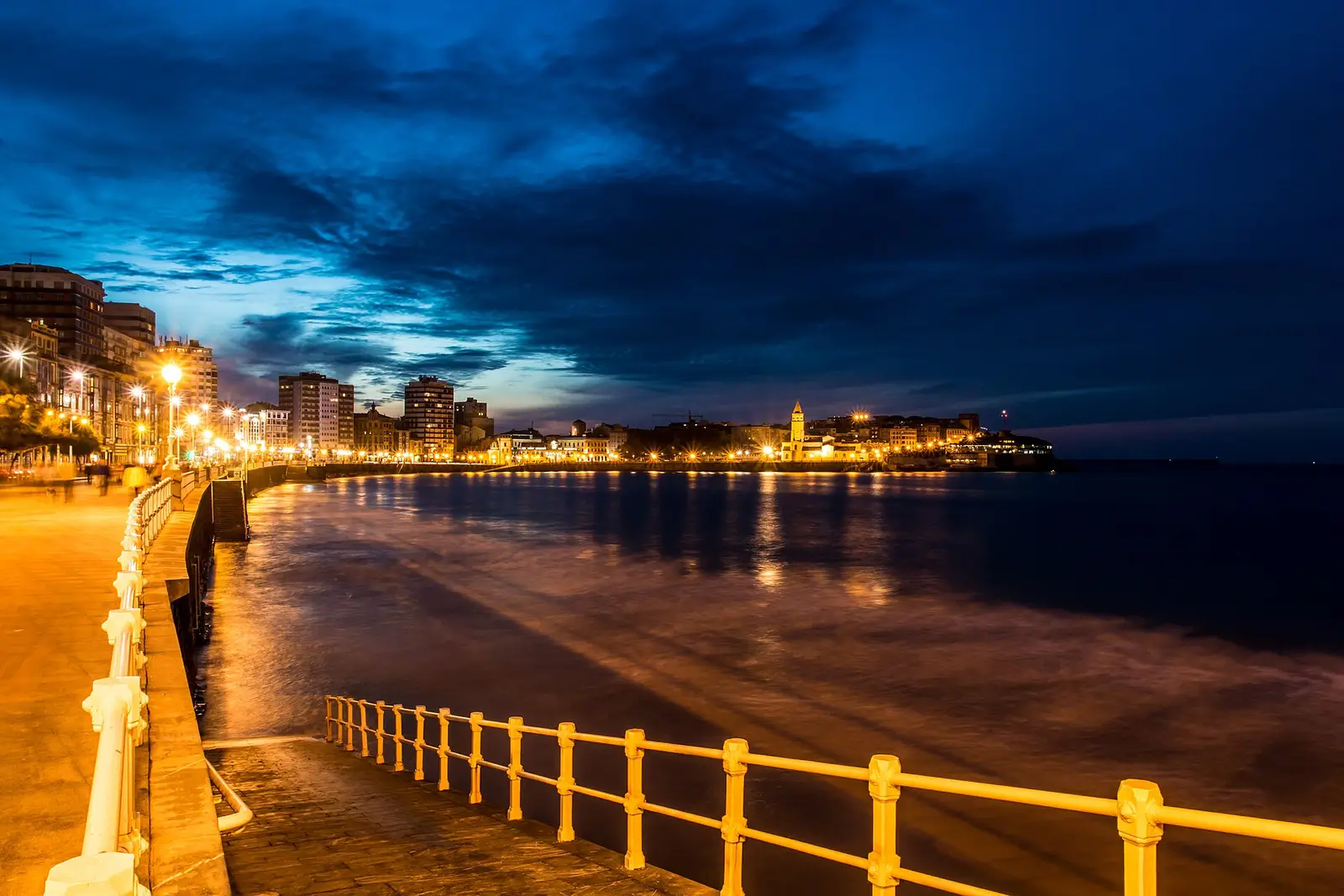
The Paseo del Muro de San Lorenzo – simply “el Muro” (“the Wall”) to locals – is Gijón’s great seafront promenade: a white railing running the full length of the city beach, busy at all hours. Joggers, dog walkers, people watching winter storms or hunting for space on the sand in August: if you want to feel the rhythm of Gijón, take a stroll here.
A two-minute history
Work on the sea wall began in 1907 and was finished in 1916, without any official opening, to hold back the sand and give the city a proper seafront. In 1933 the Escalerona was added – a grand three-flight concrete staircase down to the beach, topped by a pillar flying the city flag. The steps down to the sand are numbered, and locals use them as landmarks: “see you at number 4”.
What to see along the way
Church of San Pedro and Campo Valdés (west end)
The promenade starts below the church of San Pedro, next to Cimavilla. Under the square of Campo Valdés lie the Roman baths, and behind them the lanes lead up into the old town.
The Escalerona (centre)
The most recognisable spot on the promenade and the classic place to meet. From the top you get a fine view of the whole curve of the bay.
The mouth of the Piles (east end)
The promenade ends where the River Piles meets the sea. Across the river, the seafront walk continues towards El Rinconín, and if you follow the river inland you soon reach Isabel la Católica Park.
Tides: what you need to know
San Lorenzo changes completely with the tide. At high tide the water comes up almost to the foot of the wall and the beach virtually vanishes; at low tide it turns into a huge expanse of sand. If you want to go down to the beach or walk along the shoreline, check the day’s tide table. In stormy weather waves crash against the wall – an impressive sight, but keep your distance, as the spray reaches the promenade.
Tip: in winter, a heavy swell at high tide is one of Gijón’s great free spectacles. Watch from the top of the promenade, never from the steps.
When to go and how long to allow
- Time: about 30 minutes end to end; a good hour if you linger at the Escalerona and walk on to the Piles.
- Best time: early morning for a quiet walk; late afternoon for the light on Cimavilla and Santa Catalina Hill. More ideas in the best sunsets in Gijón.
- In summer: both promenade and beach get crowded; for beach tips, see our guide to San Lorenzo beach.
Getting there
From Plaza Mayor or Calle Corrida, the promenade is just a few minutes’ walk. It connects with Cimavilla at the west end and El Rinconín at the east, so you can link both in one walk.
What to combine nearby
- The climb to the Elogio del Horizonte through Cimavilla.
- Isabel la Católica Park, beside the Piles.
- The sculptures of El Rinconín, such as the Monument to the Emigrant’s Mother – see monuments and sculptures.
Frequently asked questions
How long is the San Lorenzo promenade?
It follows San Lorenzo beach, which is around one and a half kilometres long, from the church of San Pedro to the mouth of the River Piles. Walking it end to end at an easy pace takes about half an hour.
What is the Escalerona?
The large concrete staircase down to the beach in the middle of the promenade, opened in 1933 and topped by a pillar flying Gijón's flag. It is the city's best-known meeting point.
Why does San Lorenzo beach disappear?
Because of the tide. The tidal range is large: at high tide the sea reaches almost to the wall, while at low tide the sand stretches out enormously. Check the tide table before heading down.
Can you cycle along the promenade?
The promenade is mainly for pedestrians and gets very busy at peak times. Check Gijón City Council's current rules and cycle routes before riding.
Sources
- Wikipedia (ES) – Playa de San Lorenzo (Gijón) — 28 October 2026
- Wikipedia (ES) – Cimadevilla (Gijón) — 28 October 2026