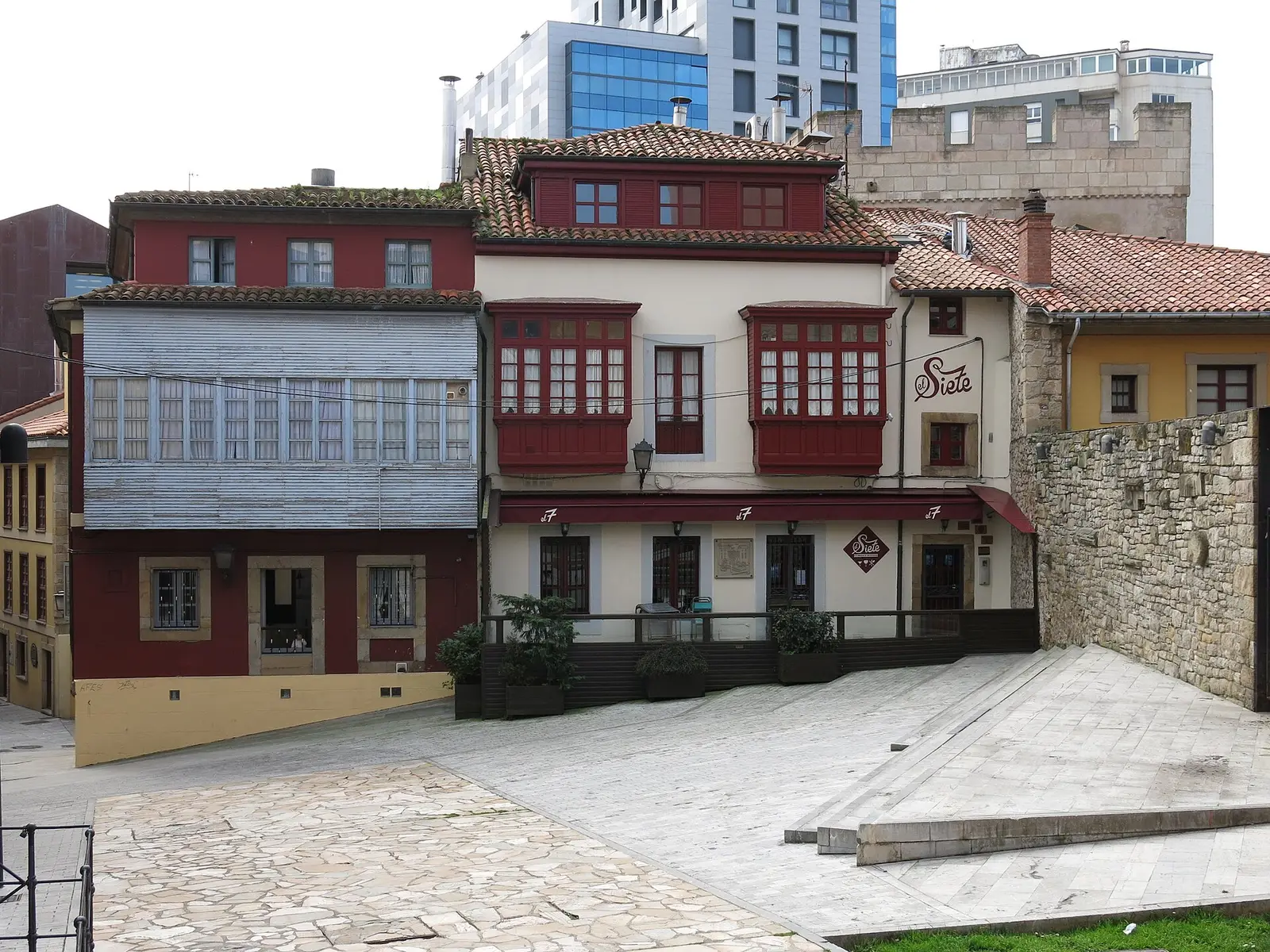
Cimavilla is where Gijón began: a small headland between the marina and San Lorenzo beach, settled in Roman times and later home to the town’s fishermen and sailors. Today it mixes Roman remains, baroque palaces, low, brightly painted houses and a lively cider-house scene. If you only have one morning in Gijón, start here.
A little history
Under Roman rule, the people of the nearby hillfort of Noega moved onto this hill, which was eventually enclosed by a wall with dozens of towers. For centuries it was the heart of the town, and from the 16th century the harbour turned it into a sailors’ quarter – the seafarers’ guild of Santa Catalina, the oldest and most powerful in town, was based here. As Gijón grew southwards, Cimavilla became a working-class neighbourhood; in recent decades it has been restored without losing its character.
What to see in Cimavilla
Plaza del Marqués and the Revillagigedo Palace
The gateway to the old town from the marina. The baroque Revillagigedo Palace (1704–1721), built around an earlier Gothic tower, forms a single ensemble with the collegiate church of San Juan Bautista and is now a cultural centre with temporary exhibitions. The square also has a monument to Pelayo, the first king of Asturias.
Roman baths of Campo Valdés
Beneath the square of Campo Valdés, next to the church of San Pedro, lie the public baths of the Roman town, now a museum. Details in our guide to the Roman baths of Campo Valdés.
Jovellanos’s birthplace
Gaspar Melchor de Jovellanos, the great Spanish Enlightenment thinker, was born in Gijón. His family home is now a municipal museum: see the Jovellanos Birthplace Museum.
Plaza Mayor and the Clock Tower
Plaza Mayor, the arcaded main square open to the sea on one side, links Cimavilla with the modern centre. Nearby, the Torre del Reloj (Clock Tower) stands beside one of the gateways into the Roman walled town; the present building is a late 20th-century reconstruction that houses the city archive.
Streets, squares and atmosphere
The real pleasure of Cimavilla is getting lost: steep alleys, little squares, fishermen’s cottages with washing hanging out and a bar on every corner. Look out for the former Augustinian convent that served as a tobacco factory from 1843 to 2002.
Santa Catalina Hill
At the top, a former military area has been a park open to the sea since the 1980s, crowned by Chillida’s Elogio del Horizonte. Do not leave without walking up.
Suggested route (2–3 hours)
- Plaza del Marqués and the Revillagigedo Palace.
- Climb through the old streets to Santa Catalina Hill and the Elogio del Horizonte.
- Walk down to Campo Valdés: Roman baths and the church of San Pedro.
- Jovellanos’s birthplace and Plaza Mayor.
- Cider in the old town, or a stroll along the San Lorenzo promenade.
Tip: in summer, climb the hill early in the morning or around sunset. There is hardly any shade at the top in the middle of the day.
Getting there
From Plaza del Seis de Agosto or Calle Corrida in the centre, it is a few minutes’ walk along the marina to Plaza del Marqués. Expect slopes, steps and cobbles, so wear comfortable shoes. If you are driving, leave the car outside the old town: see parking in Gijón.
Cider and nightlife
Cimavilla is packed with sidrerías (cider houses). Asturian natural cider is still and slightly sour, and it is served by “pouring from a height” – the waiter holds the bottle high above their head and lets a thin stream hit the side of the glass to aerate it. You get a small measure (a culín) and drink it straight away in one or two sips. Find out more in cider in Gijón. At night, especially at weekends, the old town gets lively.
Frequently asked questions
Is it Cimavilla or Cimadevilla?
Both names refer to the same neighbourhood. Cimavilla is the Asturian form and the one locals use; Cimadevilla is the Castilian Spanish form you may see on some maps.
How long do you need to see Cimavilla?
Two to three hours to wander the streets and climb Santa Catalina Hill. Add at least an hour if you visit the Roman baths or the Jovellanos birthplace museum.
Can you drive into Cimavilla?
It is best not to. The streets are narrow, steep and cobbled, so leave the car elsewhere and walk up. See our guide to parking in Gijón.
Is Cimavilla a good place to try Asturian cider?
Yes. It has one of the highest concentrations of cider houses and bars in the city, especially around Plaza Mayor and the streets rising from the marina.
Sources
- Wikipedia (ES) – Cimadevilla (Gijón) — 28 October 2026
- Wikipedia (ES) – Palacio de Revillagigedo — 28 October 2026
- Wikipedia (ES) – Torre del Reloj (Gijón) — 28 October 2026