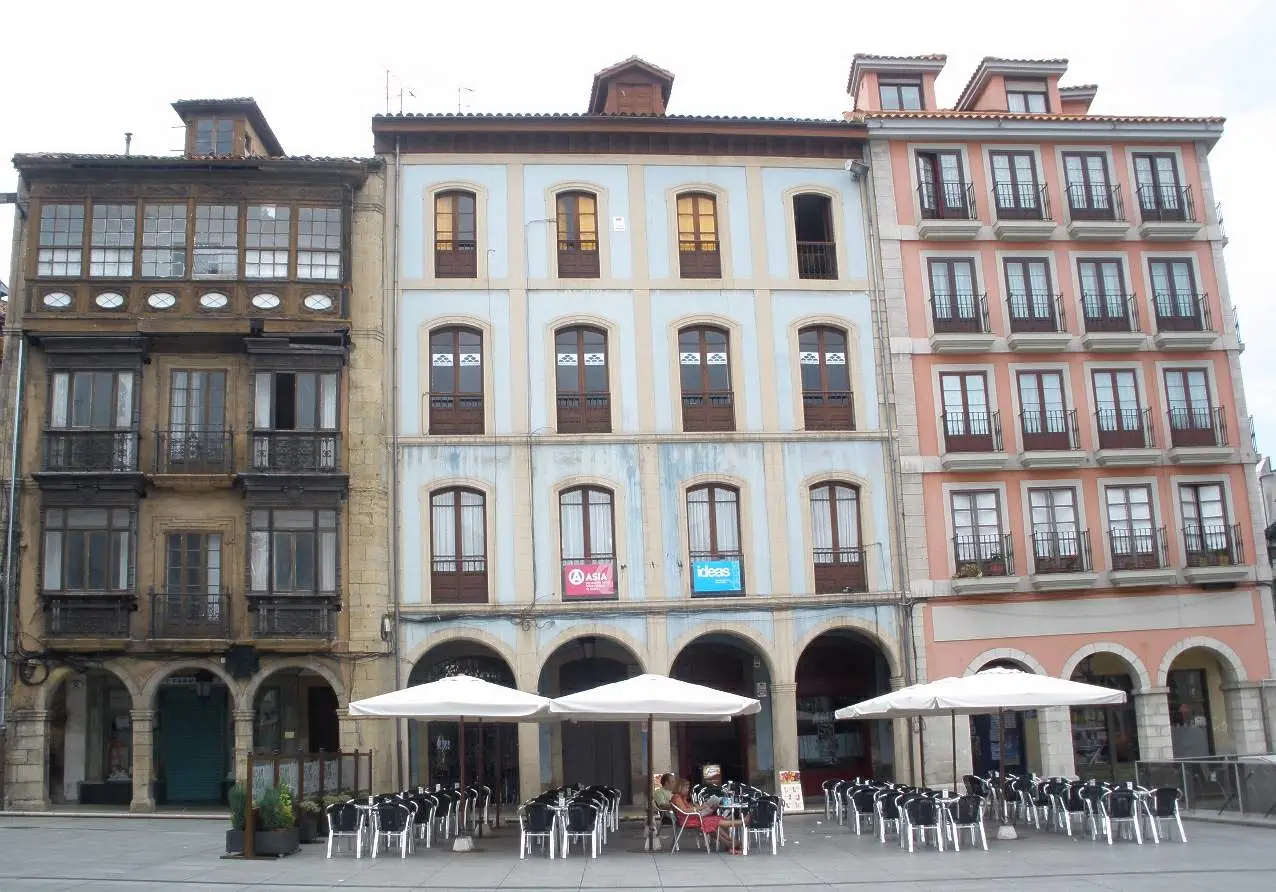
Avilés is Asturias’s third-largest town and, for many visitors, the surprise of the trip. Behind its industrial reputation lies one of the best-preserved historic centres in northern Spain, with arcaded streets, noble palaces and a characterful old fishermen’s quarter, plus a striking modern landmark: the Niemeyer Centre. It is so close to Gijón/Xixón that you can pop over for the morning and be back for lunch, or give it a relaxed full day.
Getting there from Gijón
By car: the quickest option. Avilés is about 25 km west of Gijón and the motorway gets you there in roughly half an hour, traffic permitting. Once there, park near the centre or the estuary and explore on foot; everything worth seeing is within walking distance.
By train: Avilés has a station on Renfe’s Cercanías (commuter rail) network, by the estuary and a short walk from the centre. Depending on the time of day there may be direct services or a change of train, so check routes and times on renfe.com. If you’re new to the regional network, our guide to getting to Gijón explains the basics.
By bus: there are frequent road connections between Gijón and Avilés. Check timetables and stops on alsa.es.
What to see in Avilés
The old town
The streets and buildings of the old town are a listed Historic-Artistic Ensemble, and you feel it straight away. The classic walk starts at Plaza de España, home to the Town Hall and lined with palaces such as the Palacio de Ferrera, whose former gardens are now Ferrera Park, a green space right next to the centre.
From there, wander the arcaded streets:
- Calle Galiana: long, cobbled and sloping, with arcades (soportales) along one side. It was laid out in the 17th century as the town grew beyond its walls and is now lined with bar terraces. At carnival time it hosts the famous Descenso de Galiana.
- Calle Rivero: another photogenic arcaded street with colourful houses and traditional shops.
- La Ferrería and Bances Candamo: corners of the old core where you’ll also find the Museum of the Urban History of Avilés.
- The Caños de San Francisco fountain, beside the Franciscan church.
Sabugo, the fishermen’s quarter
A few minutes’ walk from the centre is Sabugo, the medieval fishermen’s district. Here you’ll find the Romanesque old church of Sabugo and the Plaza del Carbayo, which feels like a village square within the town. It’s a pleasant spot for a drink and a taste of everyday Avilés.
Pedro Menéndez and Atlantic Avilés
Avilés is proud to be the birthplace of Pedro Menéndez de Avilés, the 16th-century admiral who founded St. Augustine in Florida, the oldest continuously inhabited European-founded city in the United States. His monument stands in Parque del Muelle and he is buried in the Romanesque church of San Antonio de Padua. Plaza de Camposagrado and the Palacio Valdés theatre complete this stroll through the town’s grander side.
The estuary and the Niemeyer Centre
A promenade along the estuary (ría) links the old town with the Niemeyer Centre, the only building in Spain by the Brazilian architect Oscar Niemeyer: a white dome, an auditorium, a tower with a viewpoint and a large open plaza. It’s worth seeing even without going inside; if you want to catch an exhibition or show, check the programme first. Its contrast with the industrial waterfront is part of the appeal.
How much time do you need?
- Half a day: old town, Galiana, Sabugo and the walk to the Niemeyer.
- Full day: add an exhibition or concert at the Niemeyer, or a nearby beach in the afternoon. With a car and time to spare, carry on west to Cudillero.
Food and local sweets
Avilés has a strong cider-house culture and good seafood. If you’ve never been to a sidrería (cider house), where cider is poured from a height to aerate it, read our guide to cider in Gijón first; the same rules apply here. For sweets, look out for marañuelas, traditional butter biscuits, and the bollo (a sweet bun), star of the Fiesta del Bollo at Easter. More dishes to try are in what to eat in Gijón.
Practical tips
Tip: Avilés works well on a rainy day thanks to the arcades of Galiana and Rivero, so it’s a good alternative to the beach when the weather turns. More ideas in our rainy day in Gijón guide.
- Guided tours: the council and the tourist office run walks around the old town. Check dates and booking on the Avilés tourism website (in Spanish).
- Carnival: the Avilés Antroxu, with its Descenso de Galiana, is one of the liveliest in Asturias. If you’re in the area at carnival time, see our page on Gijón’s Antroxu carnival too.
- Pilgrims: the coastal Camino de Santiago passes through Avilés’s old town. Planning to walk it from Gijón? Read our Camino de Santiago guide.
- Lunch times: in Spain lunch is usually served from about 13:30 to 15:30, later than many visitors expect, so plan your sightseeing around it.
- More day trips: compare options in day trips from Gijón or try Oviedo, the other big city less than half an hour away.
Frequently asked questions
How long does it take to get from Gijón to Avilés?
By car on the motorway it usually takes around half an hour, depending on traffic and where you set off from. The commuter train and the bus take a little longer; check the exact journey time for each service on renfe.com or alsa.es.
Can I get from Gijón to Avilés by train?
Yes. Avilés is on Renfe's Cercanías (commuter rail) network. Depending on the time of day there may be direct trains or journeys with a change, so check Renfe's journey planner before you go.
What can I see in Avilés in one day?
The old town (Plaza de España, Calle Galiana, Calle Rivero and Ferrera Park), the old fishermen's quarter of Sabugo, the estuary promenade and the Niemeyer Centre. Half a day covers the essentials; a full day lets you add an exhibition or a nearby beach.
What is the Descenso de Galiana?
It is one of the highlights of the Avilés carnival (Antroxu): crowds in fancy dress slide and stumble down the steep Calle Galiana, which is soaked with water and foam for the occasion.
Is the Niemeyer Centre worth visiting?
Yes, even if you don't go into an exhibition. It is the only building in Spain by the Brazilian architect Oscar Niemeyer, and its open plaza by the estuary is free to walk around. Check the programme before you go.
Sources
- Turismo Asturias – Top 10 things to see and do in Avilés — 28 October 2026
- Turismo Asturias – Avilés — 28 October 2026
- Avilés City Council – Tourism
- Renfe – Cercanías Asturias — 28 October 2026
- ALSA — 28 October 2026