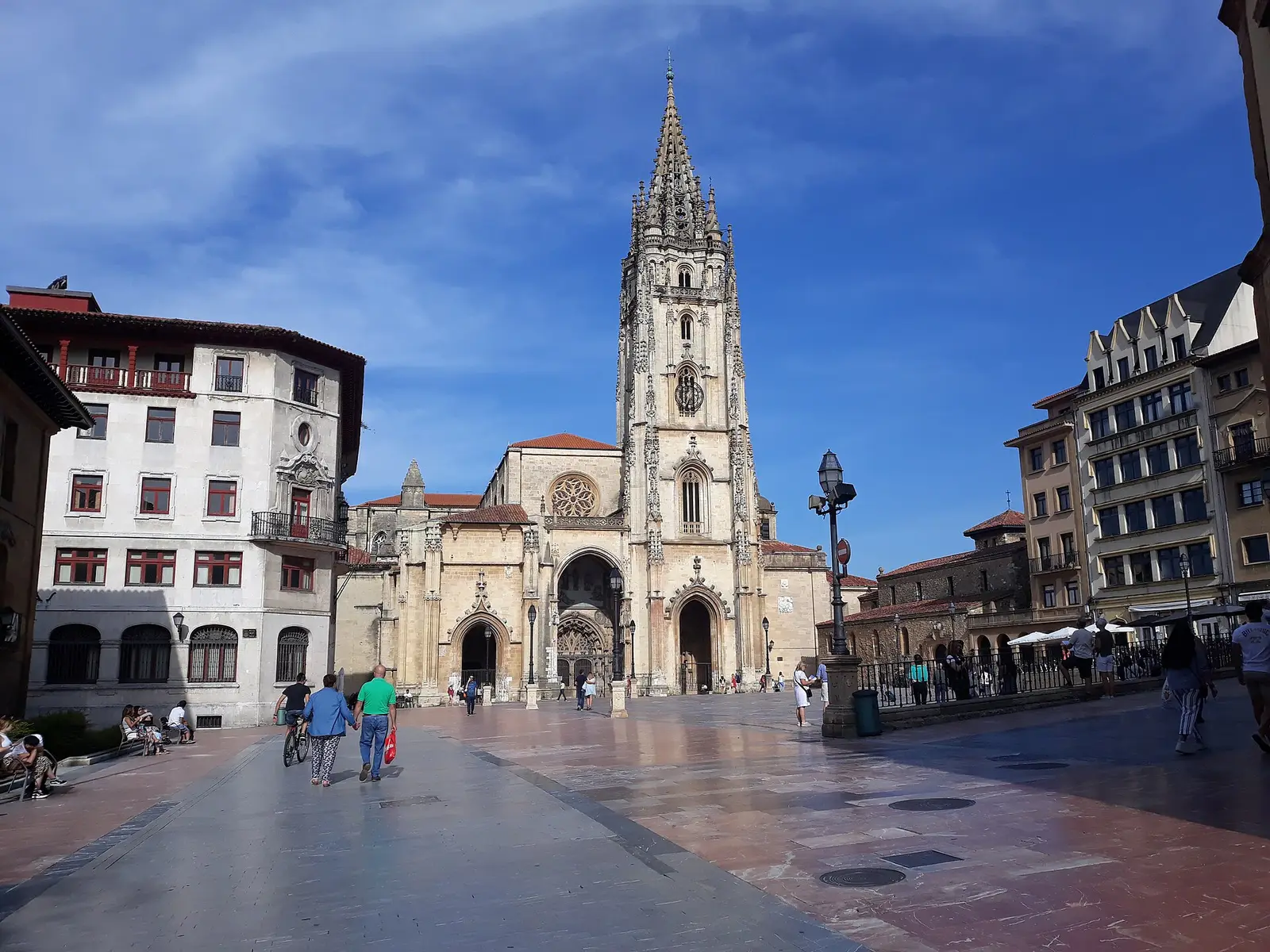
Oviedo (Uviéu in Asturian), the capital of Asturias, is so close to Gijón that many locals commute between the two every day. For visitors it is the easiest day trip without a car: a beautifully kept pedestrian old town, a cathedral with centuries of pilgrim history, pre-Romanesque monuments on the UNESCO World Heritage list and an entire street devoted to cider. It works just as well in sunshine as in rain.
What to see in Oviedo
San Salvador Cathedral
A Gothic cathedral with a slender tower that dominates Plaza de Alfonso II el Casto. Inside is the Cámara Santa (Holy Chamber), part of the original pre-Romanesque complex, which holds relics venerated since the Middle Ages, including the Holy Shroud (Santo Sudario) and the Cross of the Angels and Cross of Victory – the latter appears on the Asturian flag. The cathedral is also the starting point of the Camino Primitivo, the oldest route to Santiago de Compostela; if that interests you, see our page on the Camino de Santiago in Gijón.
The old town
- Plaza de la Constitución, with the town hall and San Isidoro church.
- Plaza del Fontán and its covered market, surrounded by arcades: a great place to see local produce.
- Calles Cimadevilla, Rúa and San Francisco, dotted with palaces and the city’s many street sculptures (including La Regenta, the heroine of Clarín’s famous 19th-century novel set in Oviedo, and a statue of Woody Allen).
- Teatro Campoamor, where the Princess of Asturias Awards ceremony is held.
Campo de San Francisco
The large city-centre park, with walkways, ponds and old trees. A good breather between sights.
The Naranco pre-Romanesque monuments
On the slopes of Mount Naranco, on the edge of town, stand Santa María del Naranco, originally a 9th-century palace of King Ramiro I, and San Miguel de Lillo. They are the finest examples of Asturian pre-Romanesque, a style found nowhere else, dating from the early Middle Ages. In town you can also see San Julián de los Prados (Santullano) and the Foncalada fountain.
Museums
The Museum of Fine Arts of Asturias and the Archaeological Museum of Asturias, both in the old town, are ideal on a wet day. For more indoor ideas, see rainy-day things to do in Gijón.
Eating in Oviedo
Calle Gascona, nicknamed the Cider Boulevard, is lined with one sidrería (cider house) after another. It is the place to try cachopo (breaded veal stuffed with ham and cheese), fabada (Asturian bean stew) or pixín (monkfish), while waiters pour cider from above their heads. Our guide to cider in Gijón explains the ritual. Before you leave, try a local pastry such as the almond-filled carbayón.
Getting there from Gijón
- By train: Renfe Cercanías line C-1 links Gijón and Oviedo; Oviedo station is a short walk from the centre. You can pay with a contactless bank card. Timetables on renfe.com.
- By bus: frequent regional services between the two cities’ bus stations. Timetables on alsa.es.
- By car: on the A-66 motorway, around half an hour without traffic. Parking in central Oviedo is limited and pricey: use a public car park and explore on foot.
For the Gijón end (stations, city buses), see getting around Gijón.
How long to spend
- Half a day: cathedral, old town and lunch on Gascona.
- Full day: add the Naranco monuments and a museum.
Tip: Mount Naranco is outside the centre and uphill. Without a car, find out beforehand how to get there by city bus or taxi, and check the monuments’ opening times, which vary by season.
Practical tips
- Sunday mornings: the old town has a lovely atmosphere, but some shops are closed.
- Rain: Oviedo has a reputation for wet weather; bring an umbrella and make use of the arcades.
- Keep exploring: for more ideas see day trips from Gijón, including Covadonga and the Lakes.
Frequently asked questions
How do I get from Gijón to Oviedo without a car?
By Renfe Cercanías commuter train (line C-1) or by regional bus, both with plenty of daily services. Either works well; you can pay for the train with a contactless bank card. Check timetables on renfe.com and alsa.es.
How long does it take from Gijón to Oviedo?
By car on the A-66 motorway it takes around half an hour without traffic. By train or bus the time depends on the service, but it is a very easy return trip in a day.
What should I see in Oviedo in one day?
The cathedral and its Holy Chamber (Cámara Santa), the old town (Plaza de la Constitución, Plaza del Fontán and its market), Campo de San Francisco park, Calle Gascona for lunch and, if you have time, Santa María del Naranco and San Miguel de Lillo on the slopes of Mount Naranco.
Are Oviedo's pre-Romanesque monuments a World Heritage Site?
Yes. Santa María del Naranco and San Miguel de Lillo were inscribed on the UNESCO World Heritage list in 1985, and the listing was extended in 1998 to include other monuments such as the cathedral's Holy Chamber, San Julián de los Prados and the Foncalada fountain.
Sources
- Turismo Asturias – Oviedo — 28 October 2026
- Turismo Asturias – Santa María del Naranco — 28 October 2026
- UNESCO – Monuments of Oviedo and the Kingdom of the Asturias — 28 October 2026
- Renfe – Cercanías Asturias — 28 October 2026
- ALSA – Destinations — 28 October 2026