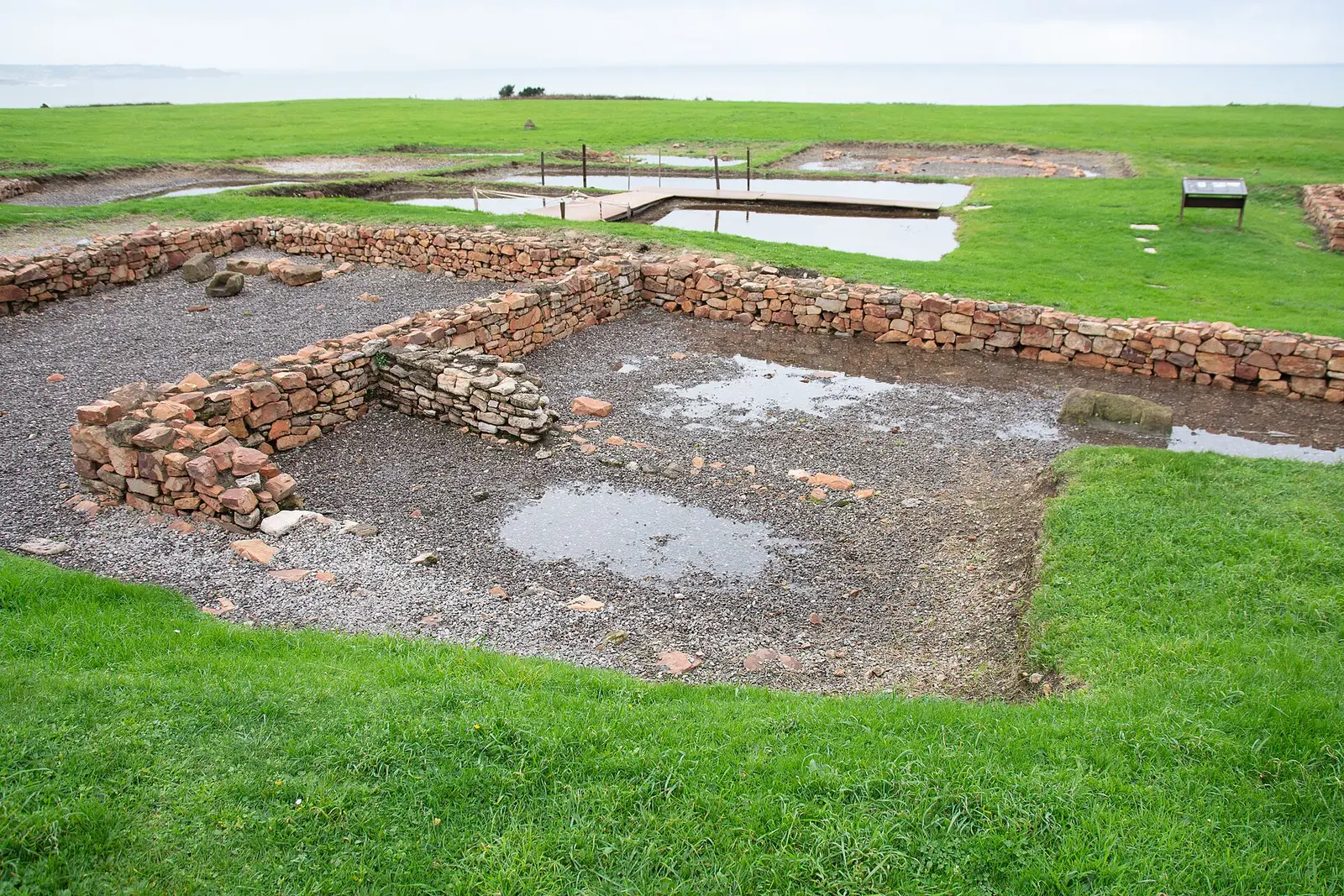
Campa Torres is one of Gijón’s most atmospheric places: a headland above the Cantabrian Sea where, some 2,500 years ago, the fortified settlement of Noega stood. Today it brings together an archaeological site, a small museum, a working lighthouse and some of the widest sea views in the area. It sits at the western tip of Cape Torres, right above the port of El Musel, and you can see it all in a couple of hours.
What it is and why it matters
The park covers around 50,000 m² at the end of the cape. Turismo Asturias describes it as the largest fortified coastal enclosure on the Asturian shoreline. The remains span the 5th century BC to the 1st–2nd centuries AD — in other words, from the Iron Age right through to the height of Roman rule.
The hillfort (a castro, as these Iron Age settlements are called in northern Spain) is identified with Noega, a town classical authors placed in the land of the Astures, the region’s pre-Roman people. Interest in the site goes back a long way: in 1783, encouraged by the Enlightenment statesman Jovellanos, the architect Manuel Reguera dug here looking for the legendary Aras Sestianas, altars dedicated to the emperor Augustus. Scientific excavation began in 1978 and continued regularly through the 1980s. The site was declared a Bien de Interés Cultural (Spain’s highest heritage protection) in 1980, and the park opened in 1989 as one of the country’s first archaeological parks.
What you’ll see
The museum. It’s housed in a Spanish Civil War bunker built to defend El Musel — a story in itself. Replicas, scale models and audiovisual displays explain what the settlement was like, so it makes sense to start here before heading outside.
The defences. On the upper part of the site you can make out a ditch cut into the rock, an outer ditch and the rampart, built in rectangular sections with rounded corners. Standing there, it’s obvious why people chose this spot: the cape can only be approached from one side.
The settlement. Lower down are stone houses — older round ones and rectangular Roman-era ones with pebble floors — plus three masonry-lined wells with steps leading down, and the remains of bronze-casting furnaces. A signposted trail with viewing points leads you round.
Torres lighthouse. The lighthouse, in service since 1924, is part of the visit and has its own, shorter opening hours.
The viewpoints. From the clifftops you can see the whole bay of Gijón to the east and the Carreño coast to the west. It’s also a good spot for watching seabirds on passage.
Tip: bring a jacket even if the day looks fine. The cape is fully exposed to north-westerly winds and feels several degrees colder than the city centre.
Opening hours and admission
According to the Turismo Asturias listing checked today, admission is free. The museum opens Tuesday to Sunday: October to March, 10:00–17:00; April to September, 10:30–19:00. The lighthouse opens 10:00 (10:30 in the warmer months) to 14:00, extended to 19:00 from 15 June to 31 August. It’s closed on Mondays, 1 and 6 January, Shrove Tuesday, 15 August and 24, 25 and 31 December. Hours can change, so double-check on gijon.es or by phone using the official listing.
Getting there
Campa Torres is about 7 km from the centre, in the Jove area beyond El Musel. Driving is easiest: head west along the coast and port, then take the road up to the cape. By bus, check the EMTUSA website for the nearest line; you’ll usually finish with an uphill walk. For general tips on transport, see our guide to getting around Gijón.
Keen walkers can combine it with a walk along the western waterfront from Arbeyal beach, though much of the way runs past port and industrial areas. We cover it in our Gijón coastal path guide.
Tips for your visit
- Pick a clear day if you can: the landscape is as much of a draw as the ruins, and fog hides half of it.
- Wear comfortable shoes: the trail is outdoors, on earth and grass, with some slopes.
- Late afternoon light over the sea is superb, but mind closing time. More ideas in best sunsets in Gijón.
- Take care near the cliffs, especially with children or in strong wind.
Pair it with Roman Gijón
Together with the Roman Baths of Campo Valdés and the Roman Villa of Veranes, Campa Torres makes up the city’s municipal archaeological museums. Seeing all three lets you follow local history from the pre-Roman hillfort to the Roman town of Gigia and rural life in late antiquity. For the rest of the city’s collections, see our guide to museums in Gijón.
Frequently asked questions
How much does it cost to visit Campa Torres?
According to the Turismo Asturias listing checked on 28 October 2026, admission is free. It's worth confirming on the city council website before you go.
What was Noega?
Noega is the pre-Roman settlement mentioned by classical writers, which researchers identify with the hillfort at Campa Torres. It was a large fortified site by the sea, inhabited from the 5th century BC into the Roman period.
How long do I need at Campa Torres?
Allow an hour and a half to two hours for the museum, the archaeological trail and the viewpoints. Add more if you enjoy watching the sea or birdlife.
Can I get to Campa Torres without a car?
It's about 7 km from the centre, beyond the port of El Musel. Check the EMTUSA city bus website for the nearest line and stop; expect an uphill walk at the end.
Is it open on Mondays?
No. According to Turismo Asturias, the museum is closed on Mondays and on certain holidays (1 and 6 January, Shrove Tuesday, 15 August and 24, 25 and 31 December).
Is it good for children?
Yes: there's plenty of open space, prehistoric houses to walk among and big views. Keep an eye on them near the cliff edges, which drop straight to the sea.
Sources
- Turismo Asturias – Campa Torres Archaeological-Natural Park — 28 October 2026
- Turismo Asturias – Lighthouse route, stage 4 — 28 October 2026
- Wikipedia – Campa Torres — 28 October 2026
- Gijón City Council – Museums network — 28 October 2026