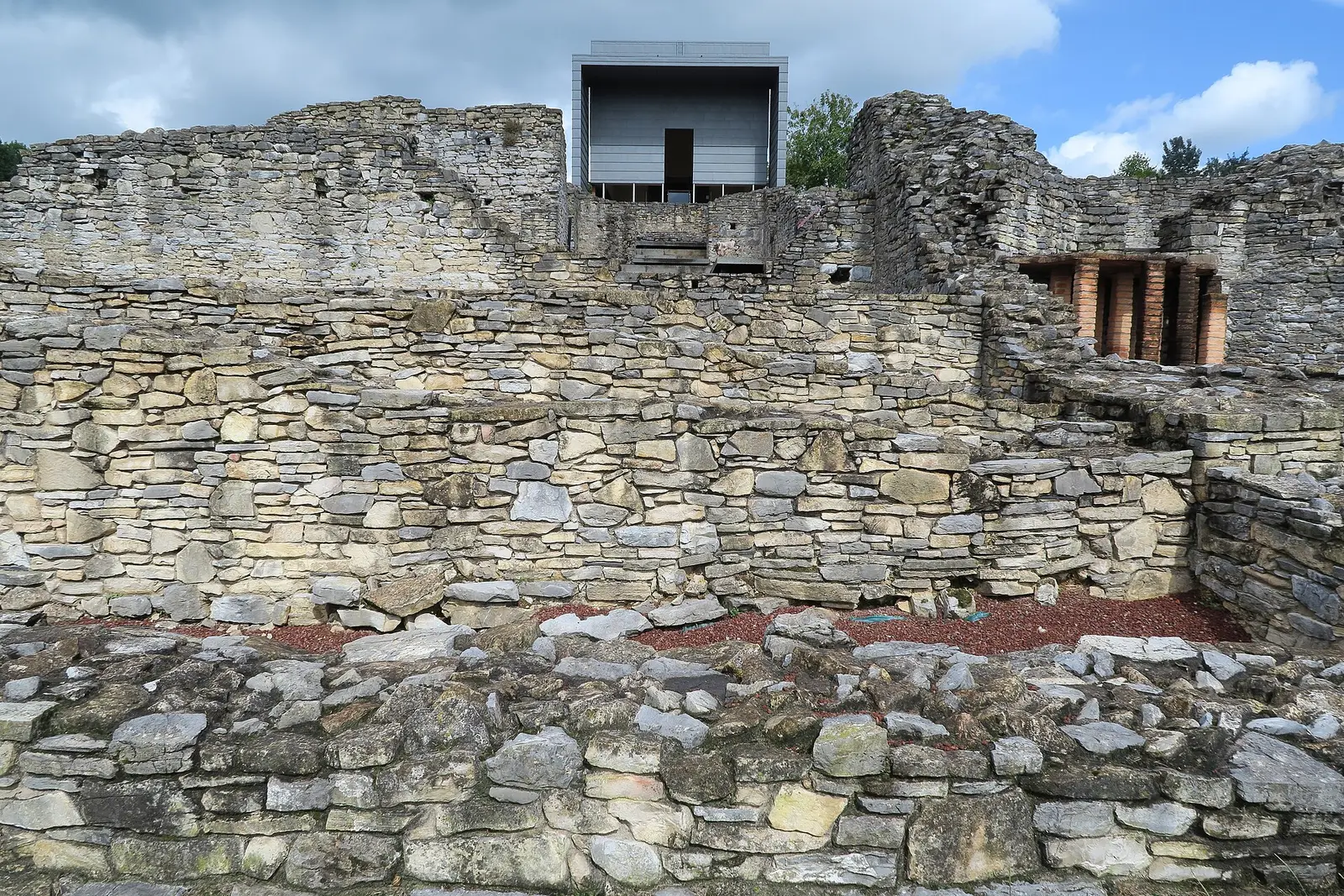
The Roman Villa of Veranes is the country house of a wealthy 4th-century landowner, preserved on a green hillside in the rural interior of the municipality of Gijón. It’s one of the best-studied Roman rural sites in northern Spain, admission is free and it’s a world away from the busy coast. It’s the natural complement to Roman Gijón in the city, or a peaceful morning out in the countryside.
What Veranes is
In Roman times much of the countryside was organised around villae: large farming estates with a grand residence for the owner. The one at Veranes was built in the 4th century over an earlier rural settlement and remained in use until the 5th century. According to Turismo Asturias, the owner was probably called Veranius — the likely origin of the modern place name — and the house was altered and enlarged in three phases during that century.
Long after the villa was abandoned, a church was built over its remains, surrounded by an early medieval cemetery. For centuries the site was known for the ruins of that church, until research revealed the great Roman house underneath. The whole complex is a Bien de Interés Cultural (Spain’s top heritage listing), and the interpretation centre opened in 2007.
What to see on site
The villa steps down the hillside in four terraces, covering roughly a hectare. As you walk round you can pick out:
- The entrance and north courtyard. The main way in was on the west side, opening onto a courtyard, with the service area — granary, kitchen and oven — to the left.
- The gallery. A long covered gallery led to the reception rooms on the east side.
- The triclinium. To the south is the formal dining hall, ending in an apse, where the owner entertained his guests (Romans dined reclining on couches).
- The baths. These take up the villa’s south front: a private bath suite with cold and heated rooms, a clear sign of the owner’s status.
- The owner’s quarters. To the north are the owner’s private room and the main hall, once paved with a polychrome mosaic, fragments of which survive.
Tip: before going down into the site, stand at the top to get an overview. Once you have the layout in your head, the terraces make far more sense.
Opening times, admission and current status
According to the Turismo Asturias listing checked today, admission is free. Published hours are Tuesday to Sunday and public holidays: 16 September to 15 June, 10:00–15:00; 16 June to 15 September, 10:30–19:00; Easter week, 10:00–17:00. It’s closed on Mondays, 1 and 6 January, Shrove Tuesday, 15 August and 24, 25 and 31 December. Access to the remains ends 30 minutes before closing.
Important: the same listing says only the open-air site can be visited and the centre’s indoor rooms are closed. Before you go, check hours and status with the city council’s museums network, as winter hours have varied in previous years.
Getting there
Veranes is in the parish of Cenero, in the rural south-west of the municipality, well away from the town. The practical option is by car on local roads. We can’t confirm a regular bus that reaches the site, so if you’re relying on public transport, check EMTUSA first or read our guide to getting around Gijón.
Practical tips
- Comfortable shoes: there are ramps, steps and earth paths between terraces.
- In the rain, with the indoor rooms closed, the visit is entirely outdoors. On a wet day you may prefer our rainy day in Gijón ideas.
- With children, turn it into a game of spotting rooms: where did they bathe? Where did they cook?
- Bring water: there are no shops or cafés right on hand in the countryside.
Gijón’s Roman trail
Veranes is one of three municipal archaeological museums, and the other two complete the story: the Roman Baths of Campo Valdés, the public baths of the Roman town at the western end of San Lorenzo beach, and Campa Torres Archaeological Park, the pre-Roman hillfort of Noega. With a full day you can see all three: start at the hillfort, carry on to the baths and finish at the villa. All the city’s collections are in our guide to museums in Gijón.
Frequently asked questions
How much does it cost to visit the Roman Villa of Veranes?
According to the Turismo Asturias listing checked on 28 October 2026, admission is free. Confirm on the Gijón city council website before you go.
Where exactly is Veranes?
In the hamlet of Veranes, parish of Cenero, in the rural south-west of the municipality of Gijón. It's not in the city itself, so a car is by far the easiest way to get there.
What can you see at Veranes?
The remains of a large 4th-century country house laid out on terraces: service area, gallery, an apsed dining hall, private baths, the owner's rooms and fragments of mosaic. A church and a medieval cemetery were later built on top.
Is the Veranes museum open?
The official Turismo Asturias listing said today that only the open-air site can be visited and the indoor rooms are closed. Check the current situation before making the trip.
How long does a visit take?
About an hour to explore the site at a relaxed pace. Note that access to the remains closes 30 minutes before the centre closes.
Sources
- Turismo Asturias – Roman Villa of Veranes — 28 October 2026
- Wikipedia – Villa romana de Veranes — 28 October 2026
- Gijón City Council – Museums network — 28 October 2026