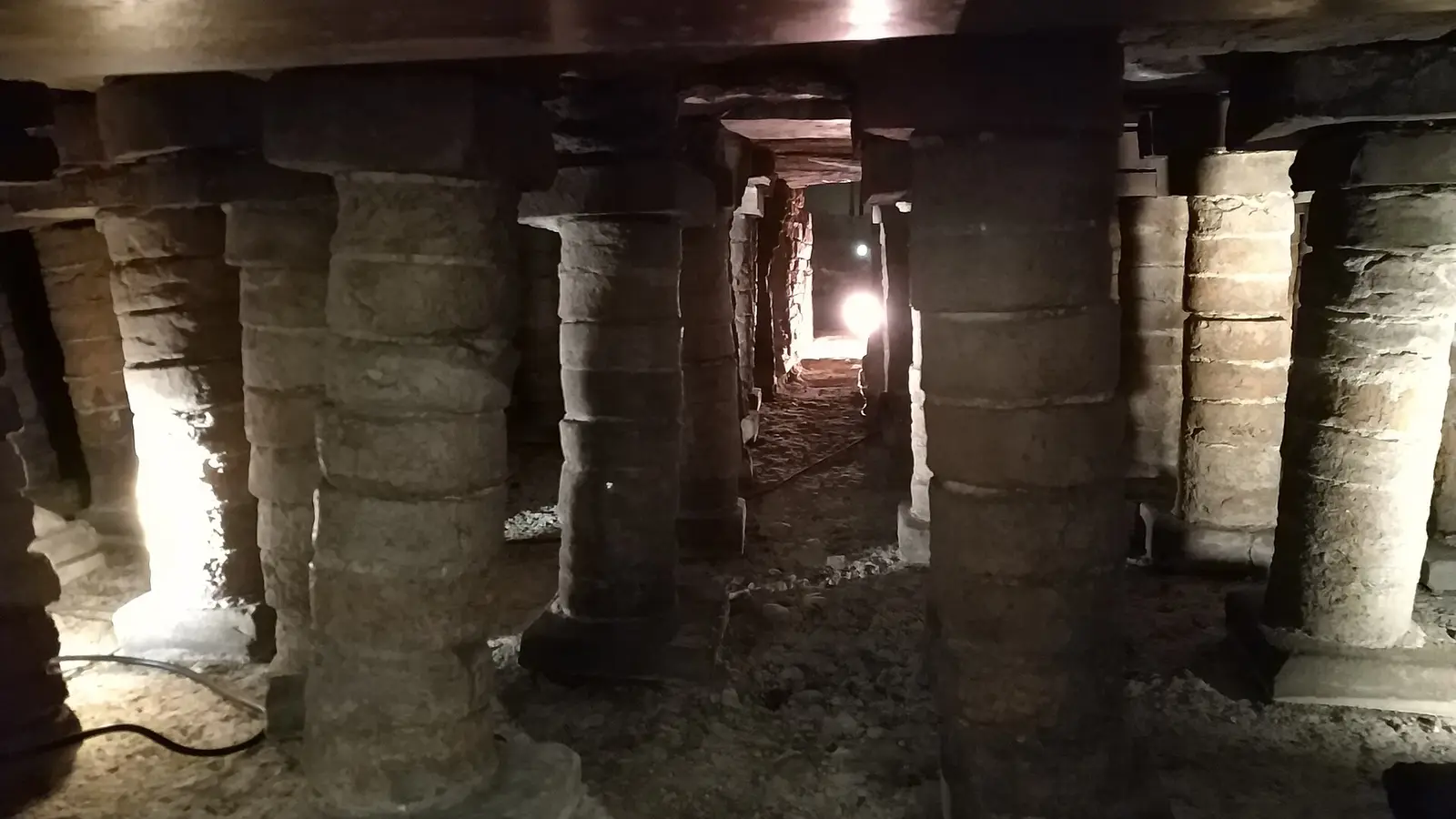
Beneath a square by the sea, at the foot of the old quarter, lies Gijón’s most important Roman building: the public baths of the ancient town. The museum lets you explore the remains and understand how a Roman bathhouse worked, including its underfloor heating. It’s a short, well-placed visit and a great way to start getting to know the city.
What they are and why they matter
In Roman times, the hill of Cimavilla was home to a small walled town. Like any self-respecting Roman settlement, it had public baths — a place to wash, but also to meet friends, do business and look after yourself. The Campo Valdés baths were built around the 1st century AD and remodelled and enlarged in the 2nd, set against the town wall and very close to today’s San Lorenzo beach.
Over time the building was buried. The church of San Pedro was built over it, and the area was later used as a rubbish dump and then as the parish graveyard. The ruins turned up by chance in 1903, during sewer works, and were recorded at the time by local scholars Calixto Alvargonzález and Julio Somoza. Systematic excavations followed in 1990, and the site opened to the public as a museum in 1995. It’s protected as a Bien de Interés Cultural, Spain’s highest heritage listing.
What you’ll see
The layout follows the sequence of a Roman bath, which took bathers through rooms at different temperatures:
- The cold room (frigidarium), to cool off.
- The warm room (tepidarium), a transition space.
- The hot room (caldarium), with a heated pool.
- The hypocaust: the underfloor heating system, with small brick pillars that let hot air from the furnace circulate. It’s usually the highlight.
Some of the walls were once decorated with frescoes. The museum is laid out around the excavated remains and helps you identify each space and what it was used for.
Tip: when you come out, take a look at Campo Valdés square and the church of San Pedro. Much of the bathhouse is still under your feet, and part of the ruins was hidden when the church was rebuilt after the Spanish Civil War.
Practical information
- Location: Campo Valdés square, at the western end of San Lorenzo beach, next to the church of San Pedro.
- Time needed: around an hour.
- Opening hours and tickets: these change with the season. Check the current details on the Gijón City Council museum network website (in Spanish).
- Getting there: a few minutes’ walk from the centre. If you’re driving, park outside Cimavilla — see options in parking in Gijón.
What to combine nearby
The baths are the ideal starting point for a full morning in historic Gijón:
- Visit the baths first thing.
- Wander up through Cimavilla’s lanes to the Jovellanos Birthplace Museum.
- Carry on to the Santa Catalina headland and the Elogio del Horizonte sculpture.
- Head back down for lunch or a cider in the old quarter. Remember that Spaniards lunch late — 2pm to 3.30pm is normal.
- In the afternoon, stroll along San Lorenzo Beach and the promenade.
If Roman and pre-Roman Gijón grabs you, add Campa Torres and the Veranes Roman villa; you’ll find both in our guide to museums in Gijón.
Frequently asked questions
How long does a visit to Gijón's Roman Baths take?
Allow around an hour to see them properly. It's a compact museum that fits neatly into a morning in Cimavilla.
How old are the Campo Valdés baths?
They were built in the early Roman Empire, around the 1st and 2nd centuries AD, when Gijón was a small walled town on the Cimavilla hill.
Where exactly are the baths?
Beneath Campo Valdés square, next to the church of San Pedro, right where San Lorenzo beach begins, in the Cimavilla district.
Are the baths worth visiting with children?
Yes, if you turn it into a detective game: find the furnace, imagine the heated floors and guess what each room was for. It's short enough that they won't get bored.
Sources
- Wikidata – Roman baths of Campo Valdés (Q6142693) — 28 October 2026
- Wikipedia – Termas romanas de Campo Valdés — 28 October 2026
- Gijón City Council – Museum network — 28 October 2026