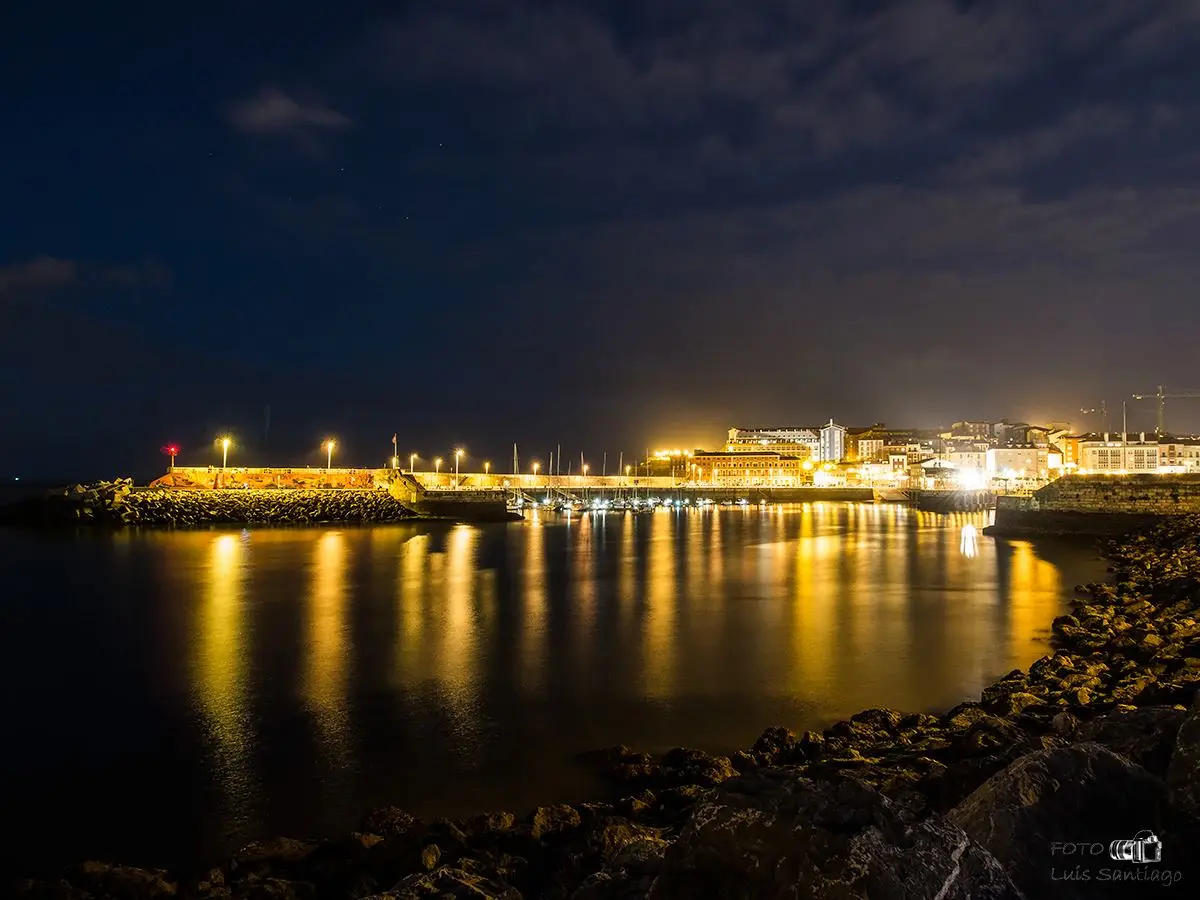
Gijón Marina fills the city’s old harbour, the one that kept the fishing quarter of Cimavilla alive for centuries. Today it’s an open waterfront of quays, yachts and terraces, with views of Santa Catalina hill, linking the old town seamlessly with Poniente beach. A stroll here in the late afternoon, as the lights come on, is one of the simple pleasures of Gijón.
Where it is and how to walk it
The marina lies west of Santa Catalina hill, below Cimavilla, and runs to Poniente beach. The basins are surrounded by pedestrian quays, so you can walk the whole loop in 30–45 unhurried minutes, stopping to look at boats and take photos.
A comfortable route:
- Start at Plaza del Marqués, by the Revillagigedo Palace and the statue of Don Pelayo (the first king of Asturias), at the entrance to Cimavilla.
- Pass the Antigua Rula, the old fish market.
- Follow the quay out along the Santa Catalina breakwater for a view of the harbour mouth and the city.
- Loop back round the basins to Muelle de Fomento, home of the Letronas.
- Finish at the curved breakwater that closes off Poniente beach to the east.
What to see
- The Letronas. Giant letters spelling GIJÓN, installed in 2011. It’s the essential photo; early morning is quieter.
- The Cider Tree (Árbol de la Sidra). A 2013 sculpture made from recycled cider bottles near the quay — a nod to the drink that defines Asturias. To understand why, read our guide to cider in Gijón.
- The Antigua Rula. The historic fish market where the catch used to be auctioned; it now houses the marina offices.
- Santa Catalina breakwater. Also known as the Lequerica breakwater, completed in 1864, it’s the harbour’s main sea defence and a great place to watch waves come in during a storm.
- The boats. Yachts, motor launches and the odd traditional craft. With luck you’ll catch a regatta coming in or going out.
Tip: the marina faces west. At sunset the sun drops behind the quays and Cape Torres, silhouetting the masts. More sunset spots in best sunsets in Gijón.
A bit of history
Gijón has used this natural shelter since Roman times. The first documented harbour basin was built in 1595 and destroyed in 1749. In the 19th century the coal trade drove new works: the Victoria quay, known locally as El Muellín, the Timber Quay and the Sociedad de Fomento quays from 1885.
Everything changed in 1907, when the port of El Musel opened on the western side of the bay. Commercial traffic moved there and the old harbour declined. Plans to convert it began in 1979, and the work to turn it into a marina was finished in 1991. Today it belongs to the Port Authority of Gijón, with the berths run under concession.
Information for sailors
According to figures compiled on Wikipedia, the marina has around 780 berths in five areas (outer harbour, inner basin, Fomentín, Fomento and waiting quay), with depths of 1.2 to 3.5 metres, water and electricity at berths, showers, laundry, fuel and a boatyard lift. Communications are on VHF channel 9. If you’re arriving by boat, confirm availability and rates directly with the marina or the Port Authority before setting out.
What to combine nearby
- Climb through Cimavilla to the Elogio del Horizonte sculpture at the top of the hill.
- Walk along Poniente to the Gijón Aquarium and the Asturias Railway Museum.
- Have a drink on one of the harbourside terraces or in a Cimavilla cider house.
- Short on time? The marina fits neatly into our Gijón in one day route.
Practical tips
- Parking: there’s an underground car park at Muelle de Fomento, but it fills up in summer and at weekends. Alternatives in parking in Gijón.
- In rough weather, keep away from the ends of the breakwaters: waves can break right over them.
- Accessibility: the quays are flat and wide, easy for wheelchairs and pushchairs.
Frequently asked questions
Where is Gijón Marina?
In the city centre, in Gijón's old harbour, west of Santa Catalina hill and the Cimavilla quarter and right next to Poniente beach.
How many berths does the marina have?
Around 780, spread across the outer harbour, inner basin, Fomentín, Fomento and the waiting quay, according to figures compiled on Wikipedia. For berths and rates, contact the Port Authority or the marina operator.
What are the Letronas?
Giant letters spelling GIJÓN on the quayside, installed in 2011 and now one of the most popular photo spots in the city.
Can you walk around the harbour?
Yes, the quays around the basins are pedestrianised and form a continuous walk between Cimavilla and Poniente. The pontoons where boats are moored are restricted, though.
What is the Antigua Rula?
The old fish market of the port, beside Cimavilla. It now houses the marina offices and other uses.
Sources
- Wikipedia – Puerto deportivo de Gijón — 28 October 2026
- Port Authority of Gijón — 28 October 2026
- Turismo Asturias – Lighthouse route, stage 4 — 28 October 2026